Leadership Summit 2026: 70+ CXOs, 12 panels, countless insights
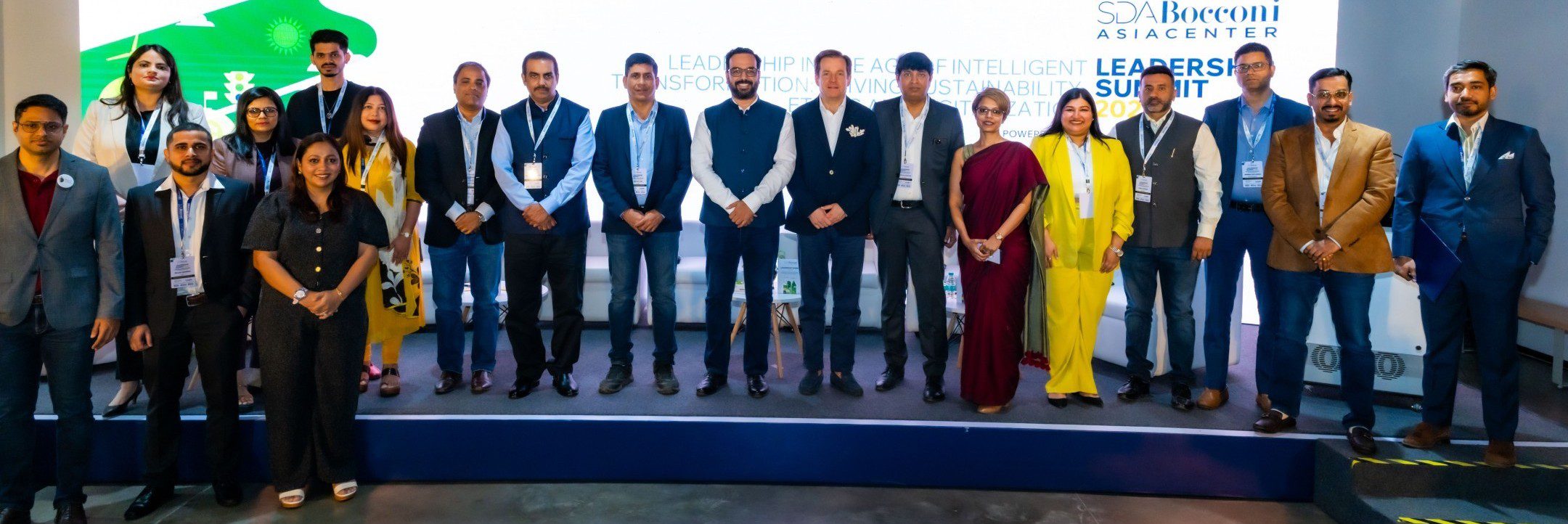
Overview In a world shaped by rapid technological advancement and digital disruption, leadership today must balance innovation with responsibility, performance with purpose, and growth with governance. This year’s Leadership Summit was held on 21 & 22 February at SDA Bocconi Asia Center. The theme, “Leadership in the Age of Intelligent Transformation: Driving Sustainability, Ethics and Digitalization,” convened 70+ industry leaders, policymakers, and thought leaders to examine how organizations can leverage emerging technologies while ensuring ethical decision-making and sustainable impact. Across two days, the Summit brought together • 70+ industry leaders • 3 keynotes• 2 fireside chats• 12 panel discussions• Moderated by SDA Bocconi alumni Keynotes Sumit Neogi, Managing Director Human Resources- MEISA region, FedEx: sustainability as a long-term strategic imperative in global logisticsNeeraj Sharma, Managing Director at Accenture: disruption cycles and where value migrates in the age of intelligent transformationVasudev Puranik, Managing Director & CIO at Accenture: “Human in the Lead”: keeping human intelligence at the centre of AI adoption Fireside Chat Mahesh Aras, Managing Director and Head of Risk and Compliance at JPMorganChase (India): leadership, risk management, and the ethics of AI in financial institutions Nishant Shekhar, MD & Partner, BCG: the consulting mindset: ambiguity, ownership, listening, and the limits of frameworks Panel Discussions 12 panels covered themes spanning AI ethics, ESG investing, circular economy, sustainable luxury, HR transformation, brand and public opinion, and the future of operations. A few highlights: Leading with Algorithm — accountability, bias, and ethics of AI (Netcore Cloud, BCG, Kyndryl, Alvarez & Marsal) Green Finance or Greenwashing? — the truth about ESG investing (Barclays, Fidelity International, RSA Security) Circular Economy — responsible business models (Amara Raj, Hitachi, Indian Oil-Adani Ventures) Stability vs Speed — sustainable tech growth (Microsoft, Visa, Decentro, JioAds) Craft, Consciousness & Carbon — responsible luxury (Mercedes-Benz, L’Oréal Luxe, Sephora, Condé Nast) In Closing From logistics to curation to moderation, every element of Leadership Summit 2026 was driven by the student cohort, making it as much a demonstration of leadership as a conversation about it. The summit’s central message was clear: sustainable, ethical, and purpose-driven leadership is no longer aspirational. It is the expectation. Join the SDA Bocconi Community
SDA Bocconi Asia Center and L&T Celebrate Convocation of IEMB–Project Management, Class of 2026

SDA Bocconi Asia Center, in collaboration with the Larsen & Toubro Institute of Project Management (L&T IPM), celebrated the convocation ceremony of the International Executive Master in Business – Project Management (IEMB-PM), Batch of 2025–26, marking the successful completion of a transformative academic journey for L&T professionals. Prof Veronica Vecchi, Academic Director, IEMB The welcome address was delivered by Prof. Veronica Vecchi, Academic Director – IEMB, who congratulated the graduating cohort and reflected on the rigour, resilience, and leadership growth demonstrated by the participants throughout the program. This was followed by an address from Mr. Alessandro Giuliani, Managing Director, SDA Bocconi Asia Center, who said “Today marks the convocation of the 2nd batch of the L&T IEMB-PM program. We are proud to partner with an organisation that is making an impact on a global scale through projects that shape our daily life, with professionals gaining the tools and skills necessary to manage these global projects.” He emphasized the strategic significance of the custom executive education partnership between SDA Bocconi and Larsen & Toubro and the program’s role in developing future-ready leaders capable of managing complex global projects that shape modern society. Alessandro Giuliani, Managing Director, SDA Bocconi Asia Center honoring the Chief Guest, Mr Satish Palekar, Executive VP & Head of L&T Energy – CarbonLite Solutions In his address as Guest of Honour, Mr. Satish Palekar, Executive Vice President and Head of L&T Energy, CarbonLite Solutions, emphasized the strategic relevance of the L&T IEMB-PM program in L&T’s growth journey and the value of custom executive education delivered through the SDA Bocconi Asia Center partnership in developing execution excellence. He highlighted how global shifts demand new approaches to mega project delivery, stressing key learnings such as maintaining an enterprise view, cultivating agile cultures, and developing robust supply chain strategies. Mr. Palekar reminded graduates that while processes form the foundation of project management, it is leadership, mindset, and soft skills that truly drive successful delivery—”processes do not deliver projects, leadership does.” A key highlight of the ceremony was the announcement of the Top 3 Rankers of IEMB-PM Batch 2: 1st Rank: Gouri Prasad Palla 2nd Rank: Srusty Anand 3rd Rank: Niklesh Cheraku The convocation concluded with the proclamation of the batch and closing remarks by Prof. Rajiv Nehru, Dean, L&T Institute of Project Management, who applauded the graduates for their perseverance and commitment to continuous learning. The IEMB-PM is a custom-designed executive program delivered over multiple modules, combining strategic planning, risk management, execution leadership, and experiential learning through simulations and real-world project contexts. The program reflects the shared vision of SDA Bocconi Asia Center and Larsen & Toubro to develop leaders capable of managing complexity in global project environments. The ceremony celebrated not only academic success but also the personal and professional growth of the graduates, made possible through the collective efforts of the faculty and the L&T IPM leadership team. Congratulations to the IEMB-PM Class of 2026. We wish the graduates continued success as they lead impactful projects and contribute to L&T’s legacy of excellence.
SDA Bocconi Asia Center Celebrates IEMB Batch 9 Convocation

On January 17, 2026, the 9th batch of SDA Bocconi’s International Executive Master in Business (IEMB) program celebrated their convocation with immense pride and enthusiasm. This remarkable cohort of seasoned professionals successfully completed 15 months of rigorous academic work, representing diverse industries and bringing with them rich corporate experience. The IEMB program, equivalent to an Executive MBA, has consistently been a cornerstone of SDA Bocconi’s program portfolio at its Asia Center. With SDA Bocconi ranked 6th in Europe by the Financial Times Business School Rankings 2024 and 4th worldwide for Global MBA Rankings 2025, the institution continues to set benchmarks in executive education globally. Now in its 10th year, the IEMB program continues to attract exceptionally accomplished professionals who represent the best of India’s corporate leadership. This year’s cohort exemplifies the calibre we have come to expect—with an average of 16 years of professional experience, the participants include C-suite executives and senior leaders from organisations such as Accenture, Axis Bank, Reserve Bank of India, Microsoft, Credit Suisse, Reliance Industries, Mastercard, Tata Chemicals, Ernst & Young, HDFC Life, Samsung, among others. Their diverse industry perspectives and strategic insights significantly enriched the learning experience, setting a benchmark for executive education. Distinguished Faculty and Leadership The ceremony was graced by distinguished faculty and leadership from SDA Bocconi Asia Center, including Prof. Veronica Vecchi, Academic Director of IEMB and Professor of Practice of Business Government Relations; Alessandro Giuliani, Managing Director of SDA Bocconi Asia Center; and Prof. Shibani Belwalkar, Program Director of IEMB and Professor of Human Resource Management, who shared insights on the transformative journey the students undertook. The evening featured a heartfelt address by the IEMB class representative, Seshadri Viswanathan, Chief New Business Development Officer at Stesalit Systems Ltd, capturing the essence of the program's impact on the cohort's professional and personal growth. Recognizing Academic Excellence At the IEMB Convocation, the institution proudly recognized the Class of 2026 rank holders who exemplified academic excellence throughout their journey: 1st Rank – Rachit Gupta, Business Development and Portfolio Leader, TCS2nd Rank – Pankaj Nagpal, Vice President, Macquarie Group3rd Rank – Kaustav Dutta, Consulting Manager, AVEVA These exceptional achievers demonstrated outstanding commitment to academic rigor while balancing demanding professional responsibilities, embodying the spirit of executive education excellence that SDA Bocconi champions. A Transformative Educational Experience The IEMB program offers a comprehensive curriculum that blends global expertise with local relevance. With 105 credits under the European Credit Transfer System (ECTS) recognized by European laws, the program provides world-class education through SDA Bocconi’s distinguished faculty of 400+ professors and adjunct faculty members from around the globe. A highlight of the IEMB experience is the compulsory international immersion at SDA Bocconi’s Milan campus, which includes highly interactive lectures, business role plays and simulations, company visits, guest speakers, and cultural activities that provide unparalleled global exposure. Joining a Global Alumni Network This momentous occasion marked the culmination of 15 months of dedication, hard work, and transformation. The IEMB Class of 2026 now joins SDA Bocconi’s prestigious global network of over 140,000 alumni worldwide, spanning 280+ partner schools and holding positions of influence across industries and geographies. With SDA Bocconi consistently ranked among the top business schools in Europe and globally, these graduates carry with them not just a degree, but the prestige, network, and capabilities to drive meaningful change in their organizations and industries. About SDA Bocconi Asia CenterSDA Bocconi Asia Center is a pan-Asian hub in Mumbai that has been delivering Executive Education and Postgraduate Programs designed by SDA Bocconi School of Management, Italy, since 2012. The center serves as a bridge between European academic excellence and Asian business realities, offering programs that combine global curriculum standards with relevantlocal practices.
My Milan Immersion at SDA Bocconi: A Journey Beyond the Classroom

I am Nishtha Wadhawan, an International Master in Business student (Class of 2026), currently at the tail-end of my international immersion semester at SDA Bocconi School of Management, Milan. My path to IMB began with a BBA LLB Honours from Amity Law School, Noida (Silver Medallist, Batch Rank 2) and an NMAT score of 233.While the Mumbai terms went beyond expectations of the kind of practical knowledge I would receive during the program, the Milan term is going to be etched in my memory as a life-changing period. What I expected to be a straightforward academic term has turned into something much more significant—a complete reset of how I understand business and leadership. When Theory Becomes Reality My four core electives this semester have changed how I approach business problems: E-commerce Strategy: Platform economics, marketplace dynamics, and how digital brands scale internationally Network Leadership: Influencing without authority, managing distributed teams, navigating organizational complexity Digital Advertising: Data-driven campaigns, consumer psychology in digital spaces, ROI optimization Sustainability: Integrating environmental strategy into core business decisions, beyond CSR Milan serves as a live case study for these concepts. The city’s design shows positioning strategy in action. Consumer behavior demonstrates digital advertising principles. Architecture proves sustainability is a business requirement, not an add-on. This semester brings together students from over 100 countries – exposing me to perspectives I hadn’t considered. I collaborate with MBA candidates from diverse backgrounds and countries, such as Chile and Switzerland, turning international diversity into a practical advantage rather than a program feature. The City That Teaches Without Speaking Beyond academics, Milan provides balance. Morning cappuccinos at my neighborhood café ground me. Tram rides to campus offer daily reflection time. Evenings along the Navigli canals remind me that ambition needs stillness. Home-cooked meals prove that not everything valuable happens in classrooms. Weekend trips across Europe—Paris, Barcelona, Rome, Budapest—have each raised important questions: What makes something endure? How do cultures shape commerce? What deserves preservation versus disruption? What I’m Taking Home The transformation runs deeper than I expected. I’m returning with more than course credits. I’m returning with: A nuanced understanding of global business systems Awareness of my capacity to perform under pressure An appreciation for balancing ambition with reflection The official metrics will show completed coursework and exam results. The real gains are harder to measure: seeing systems instead of isolated subjects, finding clarity in complexity, and leading with both conviction and cultural awareness. Milan didn’t just host my education—it changed how I think and make decisions. I’m leaving with a new perspective, more discipline, adaptability, and an expanded understanding of European culture.
Navigating Cross-Domain Leadership: Anand Jha on Curiosity, Creativity, and the Power of Continuous Learning
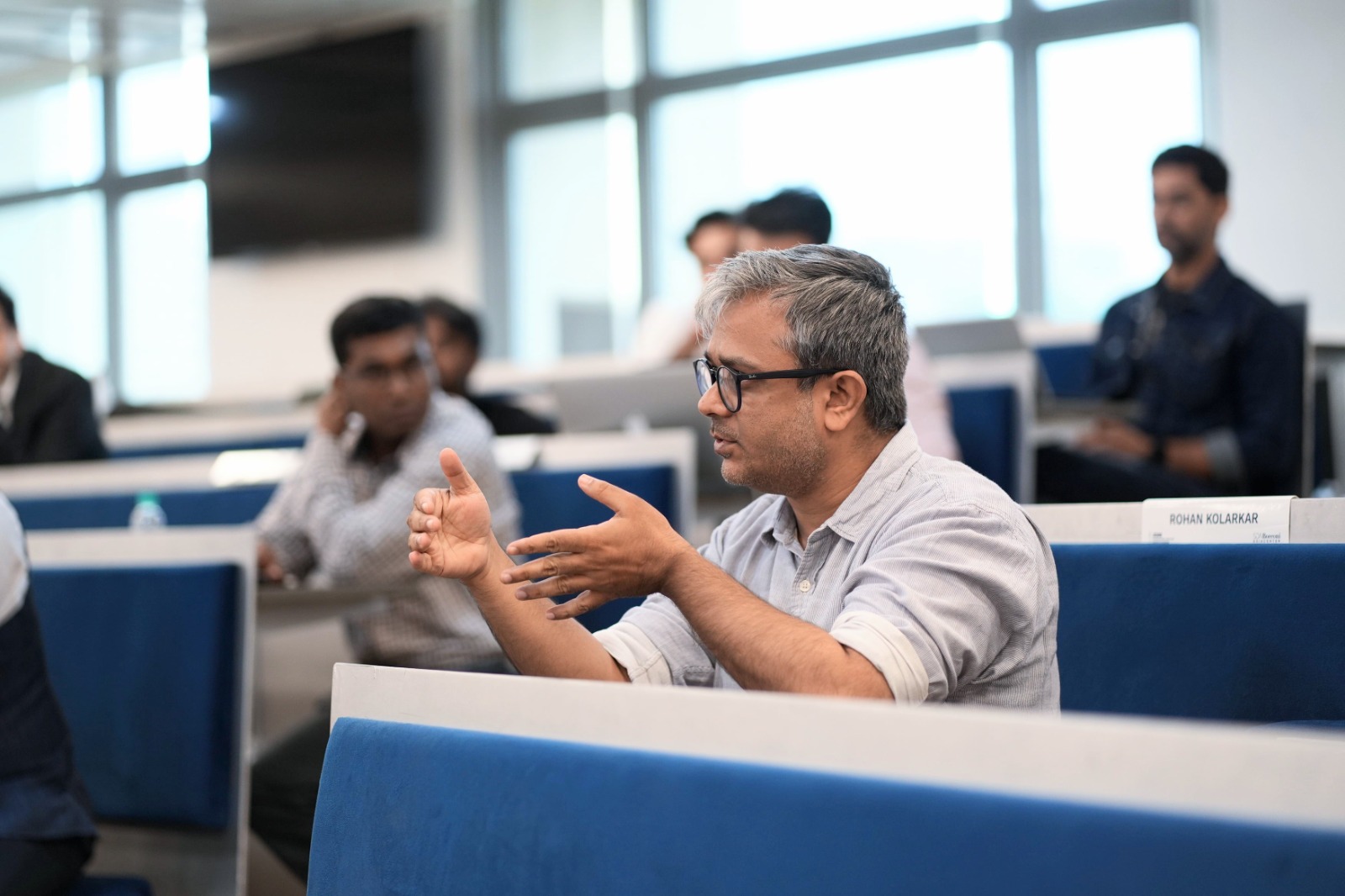
About the Series – For Your Insight This feature is part of For Your Insight—a thought leadership initiative by SDA Bocconi Asia Center, the pan-Asian hub of SDA Bocconi School of Management. The series brings together perspectives from our students, alumni, faculty, and industry experts, showcasing stories that reflect the value of an SDA Bocconi education and the excellence we strive to deliver. Through real-world narratives and career journeys, For Your Insight explores how business leaders are navigating transformation, innovation, and responsibility in a fast-changing world. In an era where specialization often dominates career conversations, the ability to navigate multiple domains with depth and agility has become a rare and valuable leadership trait. For professionals like Anand Jha, Vice President of Product Development at Hero Cycles and International Executive Master in Business – batch 8 alumnus at SDA Bocconi School of Management, this multidisciplinary journey isn’t just about collecting experiences—it’s about building what he calls “cross-sectionality,” a unique vantage point shaped by curiosity, creativity, and value creation. With over 18 years of leadership experience spanning automotive design at General Motors, healthcare innovation at 1mg, and consumer robotics at Miko, Anand brings a rare combination: deep expertise in design paired with strong commercial acumen. His career exemplifies what it means to lead across diverse contexts—from designing vehicle interfaces for Chevrolet Volt to scaling diabetes subscriptions from 6 to 1,000 orders per day, to achieving significant e-commerce turnarounds at Hero Cycles. Anand’s journey also reflects the transformative value of pursuing an Executive MBA with SDA Bocconi Asia Center—a decision that has shaped not only his strategic thinking but also his approach to leadership and community building. In this conversation, we explore how Anand’s multifaceted career has shaped his leadership philosophy and what it means to balance creativity with commercial objectives, maintain a learning mindset, and build lasting connections through community. 1. You’ve worked across diverse industries—from healthcare to mobility. What has guided your career choices over the years? My choice of domains has always been shaped by three underlying threads: curiosity, technology, and value creation. Curiosity has been a guiding force throughout my career. Understanding why a product or service is used, who uses it, how it fits into their lives, and what creates lasting value has brought me immense satisfaction. This curiosity has also enabled me to transfer skills across categories—applying learnings from one domain to another. Working across diverse segments and roles provides multiple lenses through which to view the same problem, leading to a more well-rounded and nuanced perspective. A multidisciplinary, multi-domain journey builds a kind of cross-sectionality that becomes uniquely your own. It sharpens your ability to generate insights drawn from varied experiences. Curiosity sustains this process—it allows one to think from first principles and maintain a beginner’s mind. In a rapidly changing world, balancing deep experience with a sense of fresh inquiry is a valuable skill. It also prevents fatigue; the mind stays fresh when it is constantly learning. I’ve always been drawn to technological inflection points that redefine how society functions. The transitions from analog to smartphones, and now from smartphones to AI, have each represented opportunities to ride powerful tailwinds. Being part of such shifts enables one to grow inorganically—professionally and intellectually—as the world around transforms. Finally, my professional choices have consistently followed a value-creation vector. Moving from product research to product management, and eventually to managing P&L, has been an intentional progression—each step designed to deepen my understanding of what truly makes a business tick and how to create greater value at scale. My choice of domains has always been shaped by three underlying threads: curiosity, technology, and value creation. Curiosity has been a guiding force throughout my career. Understanding why a product or service is used, who uses it, how it fits into their lives, and what creates lasting value has brought me immense satisfaction. This curiosity has also enabled me to transfer skills across categories—applying learnings from one domain to another. Working across diverse segments and roles provides multiple lenses through which to view the same problem, leading to a more well-rounded and nuanced perspective. A multidisciplinary, multi-domain journey builds a kind of cross-sectionality that becomes uniquely your own. It sharpens your ability to generate insights drawn from varied experiences. Curiosity sustains this process—it allows one to think from first principles and maintain a beginner’s mind. In a rapidly changing world, balancing deep experience with a sense of fresh inquiry is a valuable skill. It also prevents fatigue; the mind stays fresh when it is constantly learning. I’ve always been drawn to technological inflection points that redefine how society functions. The transitions from analog to smartphones, and now from smartphones to AI, have each represented opportunities to ride powerful tailwinds. Being part of such shifts enables one to grow inorganically—professionally and intellectually—as the world around transforms. Finally, my professional choices have consistently followed a value-creation vector. Moving from product research to product management, and eventually to managing P&L, has been an intentional progression—each step designed to deepen my understanding of what truly makes a business tick and how to create greater value at scale. 2. Having transitioned from a design background to business leadership, how do you balance creativity with commercial objectives? Creativity, in an enterprise context, ultimately serves commercial objectives. It is accountable for the value it creates. That said, creativity engages a very different set of muscles than business thinking. Creativity invites a state of play—where one can suspend the fear of failure, simulate possibilities, think beyond convention, and take larger leaps. Business thinking, by contrast, is analytical and grounded in the optimization of risk and reward. When combined, these two modes can create immense strength for any business leader. As a creative professional, I can think non-linearly even in constrained situations; as a business practitioner, I understand those constraints and risks with clarity. I find creativity and commerce deeply complementary—provided one learns to balance both faculties effectively. In my current role, when I review category projections and growth,
HR1 2025: Rewriting Workforces Through Change, Culture & Capability

SDA Bocconi Asia Center Hosts Landmark Gathering of HR Leaders in Mumbai On November 29, 2025, SDA Bocconi Asia Center convened India’s foremost HR leaders in Mumbai for HR1 2025, a transformative platform amplifying innovative ideas shaping the nation’s future talent landscape. The event brought together industry experts to explore how organizations can navigate constant disruption through effective change management, strategic upskilling, and adaptive workforce policies. Under the overarching theme “Rewriting Workforces Through Change, Culture and Capability,” the conclave featured four dynamic panel discussions addressing the most pressing challenges facing human resources today: artificial intelligence integration, cultural evolution, multigenerational workforce management, and the rise of alternative talent models. Opening Remarks: Setting the Stage for Transformation The conclave commenced with opening addresses from Mr. Alessandro Giuliani, Managing Director of SDA Bocconi Asia Center, followed by an industry leader address from Prof. Maurizio Poli, Senior Lecturer in Decision Sciences & Business Analytics at SDA Bocconi School of Management & Academic Director of the International Master in Business program. Their remarks framed the day’s discussions around the urgent need for organizations to remain agile, innovative, and future-ready in an era defined by rapid technological advancement and evolving workforce expectations. Panel 1: Smarter Systems, Stronger People – The AI Shift in HR Strategy The opening panel positioned artificial intelligence not as a replacement for human capability, but as a strategic enabler that amplifies human potential across business functions. Featured Speakers: Ramakrishna Vyamajala, CHRO – Home First Finance Rekha Desai, Head HR – BioGenomics Manoj Kumar Sharma, President & CHRO – Aarti Industries Naresh Rajendran, Director HR – Europe & IMEA Region (Water Utility Business), Grundfos Moderator: Dr Shibani Belwalkar, Head of Executive Education and Professor of Human Resource Management at SDA Bocconi School of Management’s Asia Center The panelists explored how AI is revolutionizing talent acquisition, succession planning, operational control in manufacturing and pharma sectors, and customer experience in financial services. A critical insight emerged: AI must be viewed as a comprehensive business strategy rather than merely an HR initiative. The discussion emphasized several key themes including workforce upskilling and reskilling initiatives, building confidence across different generations of workers, fostering outcome-driven organizational cultures, and fundamentally redesigning HR roles for an AI-augmented workplace. The panel’s unified message resonated powerfully: AI will never replace human potential, but HR professionals who strategically embrace AI will define the future of work. Panel 2: From Culture Fit to Culture Add – The Changing Face of Inclusion The second panel delivered a thought-provoking exploration of how organizations must reimagine their cultural foundations to build genuinely inclusive and future-ready workplaces. Featured Speakers: Krithivasan S, CHRO – Prayagh Consumer Pvt. Ltd. Vijeesh Nair, Global Head – HR – Keemti Jewels Loly Vadassery, CHRO – Datamatics Business Solutions Ltd. Manmohan Kalsy, CHRO – Inbrew Beverages Priya Vasudevan, CHRO – Ex-Liberty General Insurance Moderator: Dr KJ George, Director – Learning & Development at SDA Bocconi Asia Center The discussion reframed organizational culture as a living ecosystem shaped by daily behaviors, leadership decisions, and shared narratives. A transformative shift from “Culture Fit” to “Culture Add” emerged as a defining mindset, encouraging organizations to embrace dissent, fresh perspectives, and cognitive diversity rather than seeking homogeneity. The panel emphasized that authentic inclusion must be measurable through tangible metrics such as attrition patterns, engagement depth, and promotion equity. Leaders were challenged to embody integrity, openness, and consistency while recognizing that contemporary employees, particularly Gen Z, expect transparency, purpose, and psychological safety. The discussion also addressed how hybrid workplaces require intentional rituals to maintain human connection and organizational cohesion. A powerful reminder emerged: while strategy provides direction, culture ultimately determines whether people can successfully execute it. Panel 3: Generation Clash – Redesigning Work for a Multi-Gen Workforce The third panel tackled one of the most complex challenges facing modern organizations: managing five generations working side by side, each with distinct expectations, communication preferences, and motivational drivers. Featured Speakers: Wriddhee Maitra, Head HR – Gland Pharma Mohini Palchowdhury, Global Head People & Culture – Quantiphi Analytics Saveetha Lakshmanan, Global HR Head – Tagit Arvind Tripathi, Head HR – Alembic Pharma Subramanian S, Senior Lead – APAC Early Careers, British Petroleum Moderator: Jason Enamkel, Manager – Central Team HR at Native The panel challenged common stereotypes about generational differences, arguing that core human needs remain fundamentally universal: respect, professional growth, and economic security. However, the context shaping each generation differs dramatically, influenced by factors such as economic recessions, technological advancement, and evolving social mobility patterns. Reverse mentoring emerged as an essential tool for bridging digital and cultural gaps between generations, allowing younger employees to share technological fluency while learning institutional knowledge from experienced colleagues. The panelists emphasized that modern leadership requires transparency, psychological safety, and flexibility in approach. A standout insight captured the essence of the discussion: “The needs are the same; the urgency has changed.” Organizations must adapt their leadership styles and build cultures where every generation feels genuinely heard, valued, and empowered to contribute. Panel 4: The Shadow Workforce – Managing Gig, Contract, and Remote Talent The final panel explored the rapidly expanding shadow workforce—gig workers, contractors, freelancers, and remote talent—and how this segment is transitioning from a peripheral resource to a strategic organizational asset. Featured Speakers: Amrita Kachroo Binu, Head HR – Metropolis Healthcare Aarti Kohli, CHRO – Bausch & Lomb Prakash Hegde, Founder & CEO – Sidhveda HR Solutions LLP Moderator: Meka Venkata Chalapathy, Senior Director HR – Virtusa The discussion highlighted India’s evolving labor law consolidation and how it’s reshaping formal frameworks for gig workers. Organizations are shifting from traditional role-based models to skill-based workforce architectures, recognizing gig workers as brand ambassadors who require genuine inclusion in company culture rather than treatment as temporary, disposable resources. Automation in healthcare and manufacturing sectors is fundamentally restructuring job design and workforce composition, while the introduction of social security provisions for gig workers represents a historic turning point in workforce policy and worker protections. The panel’s message was unequivocal: the shadow workforce isn’t a future trend to prepare
How Live Projects at SDA Bocconi Asia Center are preparing Future Ready Managers

Can classroom theory alone prepare MBA graduates for real-world business challenges? Organizations increasingly say no—and global MBA programs like the one at SDA Bocconi Asia Center are listening. The Evolution of MBA Education: From Theory to Practice Over the past few years, management education has undergone a rapid transformation. The traditional MBA curriculum, which focused primarily on lectures and frameworks, is now changing according to current industry expectations. Organizations now demand graduates who can bridge the gap between classroom learning and corporate application. At SDA Bocconi Asia Center, for the International Master in Business program, this expectation is met through immersive short-term Live Projects, where students work directly with organizations across diverse sectors like Marketing, Consulting, Finance, Human Resources and Operations. The Career Development Services (CDS) Office of the college plays a crucial role in sourcing Live Projects, understanding the company requirements and expectations, and ensuring that students gain skills that will help them during their internships and full-time placements. Students take on a variety of business challenges like designing marketing campaigns, evaluating financial models, creating human resource engagement strategies and optimizing supply chains. These projects help them gain competencies that are valued by recruiters. In working across different industries and functions, they also discover their professional inclinations. This hands-on exposure transforms students into professionals who are industry-ready and have an understanding of the pace, pressure, and precision that the corporate world demands. Real IMB Students, Real Business Impact Finance and Fundraising: From Classroom to Capital Markets Sahil Sharad, a current student of International Master in Business program, completed a live project with Panchayat that transformed his understanding of development finance. “I helped plan budgets and support early-stage capital-raising efforts,” he explains. “It gave me exposure to how fundraising actually works on the ground, not just in textbooks.” The project built competencies in financial modeling and stakeholder communication—skills that directly translated to his MBA internship search. Marketing Live Projects: Data Meets Strategy Aumkar Ranade worked with Mist Media Marketing and Shivom Fasteners on market research and competitive analysis. “I conducted on-ground surveys and learned how insights convert into strategies,” he shares. “Presenting to senior leaders improved my communication skills and prepared me for the next phase of my international MBA journey.” This type of hands-on marketing experience helps MBA students develop the strategic thinking that employers value most. HR and Talent Acquisition: Building People Skills Ishan Revankar’s live project with Occams Advisory focused on virtual engagement and talent acquisition. “I reimagined engagement strategies, created content series, and developed a year-round calendar aligned with global observance days,” he explains. “Understanding stakeholder coordination and end-to-end hiring processes gave me practical HR expertise beyond what MBA coursework could provide.” Consumer Insights and Brand Positioning Mehak Tawakley’s project at Aukera Jewellery centered on market research and brand strategy. “I analyzed consumer trends and competitive landscapes to inform data-backed decisions,” she says. “The project was particularly insightful for understanding how brands position themselves in crowded markets.” Why Live Projects Matter for Global MBA Students These live projects benefit both students and companies. Organizations access sharp minds, while students experience environments that textbooks can’t capture. This mutually beneficial exchange often leads to internship conversions. Through its live projects, SDA Bocconi Asia Center weaves in industry engagement throughout its curriculum. At SDA Bocconi Asia Center, every live project is an opportunity to learn and to see challenges not as obstacles, but as opportunities to think differently.
Top International B-school In India – SDA Bocconi climbs the yearly FT Rankings again

SDA Bocconi Asia Center takes immense pride in being part of an institution that consistently ranks among the world’s best in business education. The latest Financial Times Global MBA Ranking 2025 reaffirms SDA Bocconi’s position as a global leader, ranking 4th worldwide and 2nd in Europe. This achievement strengthens SDA Bocconi’s reputation as a top choice for ambitious professionals seeking a world-class business education, building on last year’s success, where the school ranked 6th in Financial Times’ European business school rankings. This consistent upward trajectory underscores its growing influence in global business education. The FT Global MBA Ranking 2025 highlights SDA Bocconi’s relentless commitment to academic rigor, career progression, and international diversity. The rankings are based on 21 key criteria, with a strong emphasis on alumni career progress, including post-MBA salary, salary increase percentage, and career advancement. Additional factors include diversity among students and faculty, faculty research output, and value for money, all assessed through alumni surveys and institutional data. “Celebrating a breakthrough is great, but celebrating a confirmation is even better,” says Stefano Caselli, Dean of SDA Bocconi School of Management. “With this year’s result, SDA Bocconi firmly establishes itself among the top 5 MBAs in the world and the top 3 in Europe. Moreover, it excels in the parameters that best reflect its core values. The numbers show that the MBA experience at SDA Bocconi has a profound, transformative impact on both the careers and lives of its participants.” SDA Bocconi’s strong performance in career outcomes, faculty excellence, and global exposure reflects its ability to shape future business leaders ready to tackle complex global challenges. Its industry-driven approach and transformative education model continue to set new benchmarks in management education. Commenting on the new rankings, Professor Leonardo Etro, Dean, SDA Bocconi Asia Center, stated, “This ranking is a reflection of SDA Bocconi’s unwavering mission—to shape global leaders through excellence, innovation, and impact. It reaffirms our commitment to delivering transformative education that empowers professionals to navigate complex global challenges. This is not just recognition of our past achievements but a testament to our continuous pursuit of excellence in management education.” At SDA Bocconi Asia Center, we celebrate this milestone as a testament to the collective efforts of our faculty, students, alumni, and corporate partners. This ranking further motivates us to strengthen our mission of delivering cutting-edge, globally recognized education tailored to the needs of dynamic markets. Alessandro Giuliani, Managing Director, SDA Bocconi Asia Center said, “Being ranked #4 worldwide and #2 in Europe is more than just an achievement—it’s a testament to SDA Bocconi’s transformative impact on global business education. For our students and alumni at SDA Bocconi Asia Center, this recognition amplifies their credentials and reaffirms their place among the world’s top business minds.” We remain committed to empowering future leaders through an educational experience that blends academic excellence with real-world impact. Our journey toward continuous improvement and leadership in business education is driven by our passion for learning, innovation, and global collaboration. Join us as we continue to shape the future of management education in Asia and beyond!
A Milestone Achieved: IEMB 8th Batch Graduation Ceremony

On February 8, 2025, the 8th batch of SDA Bocconi’s International Executive Master in Business (IEMB) program celebrated their convocation with immense enthusiasm and pride. Representing seven industries and 22 companies, this diverse cohort included professionals ranging from Managers to Directors, Vice Presidents, and Commanders. Financial Times Executive Education Rankings 2024 placed SDA Bocconi 6th globally for custom programs and 10th globally for open programs. The IEMB program, equivalent to an Executive MBA, has consistently been a cornerstone of SDA Bocconi’s program portfolio at its Asia Center. We were honored to have Mr. Walter Ferrara, Consul General of Italy in Mumbai, as the Chief Guest, along with distinguished faculties and dignitaries – Prof Leonardo Etro, Dean, SDA Bocconi Asia Center, Alessandro Giuliani, MD, SDA Bocconi Asia Center, Prof. Veronica Vecchi, Academic Director IEMB, and Prof. Shibani Belwalkar, Program Director IEMB. Mr. Ferrara welcomed the graduates to SDA Bocconi’s international community, stating: “This journey has given you a unique perspective on global economic dynamics and a tangible milestone for your future. The wisdom gained, the experiences lived, and the connections made will be instrumental in your personal and professional growth.” The ceremony also featured class representatives Shivani Shukla—a Commander in the Indian Navy managing finance and operations—and Gaurav Poddar, Head of Marketing & Product Development at TATA Chemicals Ltd. Their speeches captured the essence of the IEMB experience, with Gaurav emphasizing: “The IEMB program equips seasoned executives with the tools to lead, adapt, and drive meaningful change. As we move forward, we carry not just knowledge, but resilience, strategic acumen, and the confidence to shape the future of our organizations.” Special recognition was given to top achievers Neha Bora, Managing Director, OLS (The Online Studio), Anirudh Rajesh Galagali, Director, Finance Information System, Evolent, Darshan Valia, Software Engineer, Aabhra and Vikram Kailthya, Regional Manager, Sales & Asset Management, Voyageur Aviation Corp. for their exceptional academic performance. This momentous occasion marked the culmination of 15 months of dedication, hard work, and transformation. We are proud to welcome this outstanding cohort into SDA Bocconi’s global network of over 140,000 alumni. Congratulations, IEMB Batch 8!
SDA Bocconi and L&T Celebrate Inaugural Executive Master Graduates in Project Management
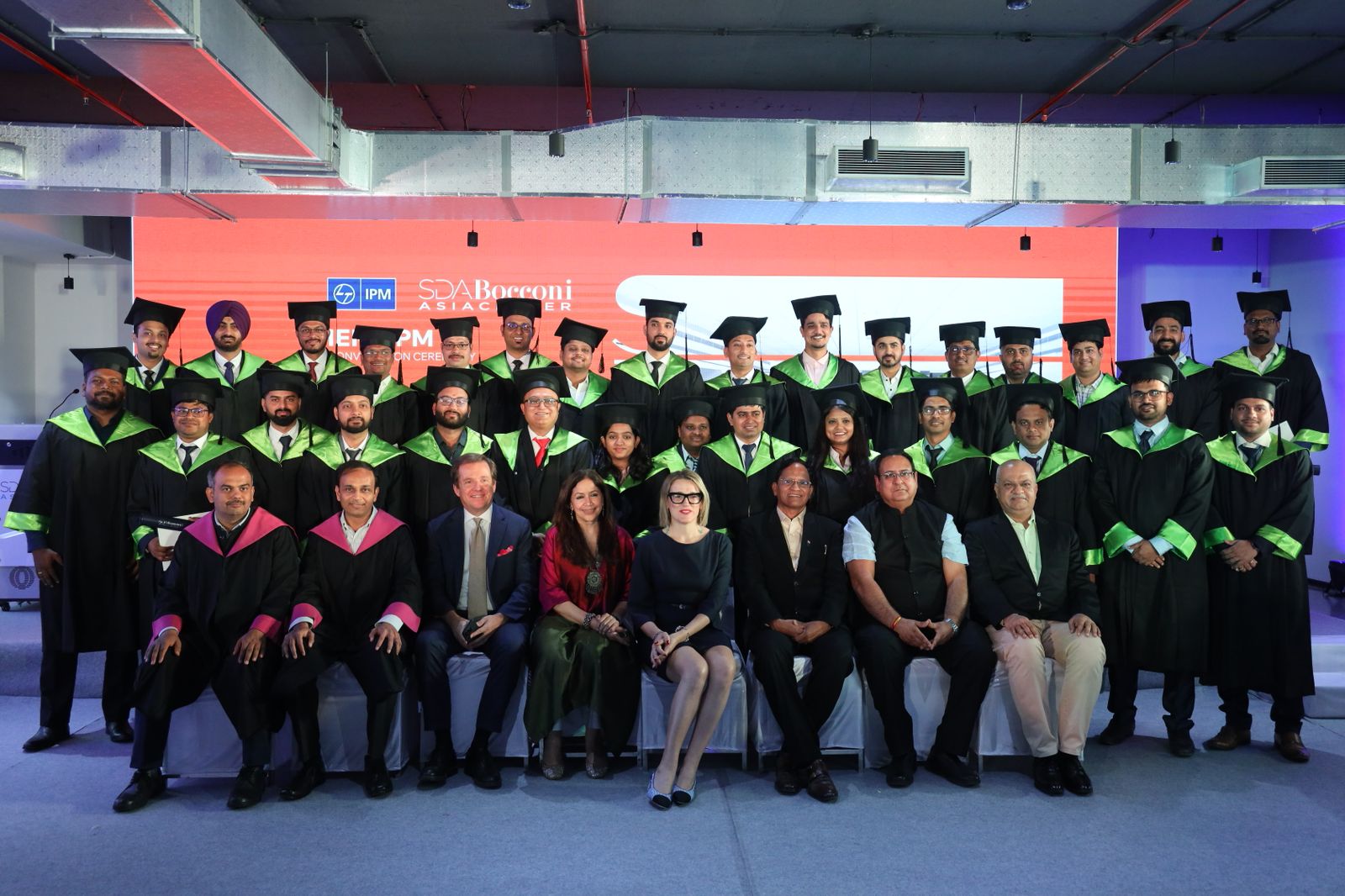
Convocation held at SDA Bocconi Asia Center on Feb 8th, 2025 Larsen & Toubro Institute of Project Management – a valued partner of SDA Bocconi since 2016 for custom programs – recently celebrated the convocation of its first graduating class of the International Executive Master in Business – Project Management (IEMB-PM), Class of 2024. The ceremony started with the L&T anthem, reminding the graduates about their commitment to the nation and its development. The convocation ceremony was graced by the presence of our Chief Guest Mr. Anil Parab, along with our distinguished faculty and leaders: Prof. Leonardo Etro, Dean of SDA Bocconi Asia Center; Mr. Alessandro Giuliani, Managing Director of SDA Bocconi Asia Center; and Prof. Veronica Vecchi, Academic Director of IEMB-PM. Addressing the graduating class, Prof Vecchi said “I am certain that this program will support the graduates as professionals and as individuals and support Larsen and Toubro to continue its roadmap to sustainability.” SDA Bocconi has ranked 6th in the world in 2024 according to Financial Times for its custom program and it continues to show its commitment to carve the path with global organisations. Alessandro Giuliani quoted “The ability to deliver custom programs is a milestone moment for us. It is also a testament to the resilience and commitment of our candidates, who skillfully balance their professional responsibilities with the program.” He further emphasized the significance of L&T, calling it “the backbone of India’s progress.” The ceremony was honoured to have Mr. Anil V. Parab, Whole-Time Director & Senior Executive Vice President (Heavy Engineering & L&T Valves), who spoke about the vital role of Project Management within Larsen & Toubro. He remarked, “Larsen & Toubro’s vision mirrors India’s thriving economy. With 70% of its business portfolio focused on projects, L&T continues to expand globally. It’s clear that you, the next generation of project managers, will drive this progress. We congratulate you for your dedication and hard work—your expertise will be pivotal to L&T’s continued success!” This custom-designed program is structured into eight modules, each lasting six days, delivered over two years. The program focuses on strategic planning, risk assessment, and execution management, equipping graduates with the skills to lead complex global projects. Through a hands-on strategy simulation, the program develops essential business and project leadership competencies, while fostering resilience, agility, and critical thinking. Professor Leonardo Etro, Dean of SDA Bocconi Asia Center, offered encouraging words for the graduates: “Your commitment to this program has equipped you with the skills and knowledge necessary to contribute directly to the betterment of Larsen & Toubro. We commend your efforts and look forward to seeing the impact you will have in shaping the future of this leading global company.” The ceremony celebrated the graduates’ hard work, dedication, and personal growth and would not have been possible without the unwavering support of the Larsen & Toubro Institute of Project Management team, including Prof. Rajiv Nehru, Dean of L&T IPM; Prof. Hiren Maniar, Deputy Dean of L&T IPM; and Prof. Avirag Bajpai, Associate Professor at L&T IPM. All the best to the first batch of the L&T IEMB PM graduates!