The Executive Master Journey of a Mother and Business Leader
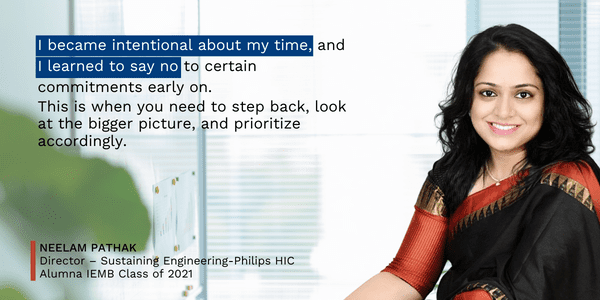
The Journey of a Mother and Business Leader Senior Professionals look for different strategies, motivations, and frameworks to balance work, education, and family. Many of them are parents who have to figure out what works best for them and their families while ensuring they stay focussed on their Executive MBA pursuits. One of the reasons why senior executives join SDA Bocconi’s International Executive Master In Business (IEMB) program in Mumbai is to get access to Europe’s top-ranked business school right here in India. SDA Bocconi School of Management is amongst a few prestigious b-schools that has triple crown accreditation and ranks 7th Worldwide for combined executive education and 3rd worldwide for custom executive education by FT Rankings 2022. Anchoring on the International brand value of SDA Bocconi becomes a key reason for choosing the IEMB Program delivered at the Asia Center, Mumbai Neelam Pandey Pathak SDA Bocconi, IEMB, Class of 2021. Director – Sustaining Engineering-Philips HIC. SWE Global Ambassador, PMI ACAC Member, VP NRV Bihar, PMP®, VMA I graduated in Mechanical Engineering in 2001 from the University of Pune and started my career with the auto behemoth Tata Motors. Over the years, however, the onus was back on me to equip myself further in order to not just excel in what I was doing but also unlock new opportunities by gaining more knowledge and qualifications outside of what the typical ‘on-the-job’ experience provided. In 2011, it led me to enrol in one of the top Indian management institutes to pursue a one-year on-campus program for executives. As usual, given the era we live in, there was this urge to further up-skill again after 4 to 5 years to counter complacency and career stagnancy. Around that time, the industry was also witnessing major transitions. Digital transformation, analytics, and globalisation were new themes that were gaining massive traction. So, the realisation set in that I needed an international executive MBA that would help me take on leadership roles in a global context. That’s when I decided to opt for SDA Bocconi’s International executive Master in Business. I realised that if I needed to transform from a managerial position to a leadership positio, and when I say leadership position, I mean taking up the entire responsibility of a business line, I had to evolve professionally and develop a global outlook. When you are working with MNCs, you need to have this global perspective about the interlinkages of economic paradigms. Pursuing my executive Master from SDA Bocconi not only allowed me to up-skill with contemporary skills but also helped me cultivate a global perspective of business realities. And it surely helped me with my next career move, as I joined an international organisation headquartered outside of India. Having that global exposure and perspective paved the way for me to undertake leadership responsibilities that required me to know how businesses operated across different regions. How did you manage the stress when juggling work, family, and education? I have two children; one was eleven years old and the other was two and a half years old when I enrolled in SDA Bocconi’s executive masters in Mumbai. From the get-go, I knew it wouldn’t be an easy journey, but I had the clarity and willingness to pursue the program. I had to communicate to my husband that the IEMB program required me to travel from Pune to Bombay every weekend, stay there for two days to attend my classes, and then return to resume my full-time job. Explaining to my husband that this would be my life for the next two years paved a path around a discussion about how we would navigate the myriad parenting challenges that came with the decision. It was important to talk to my eleven-year-old and explain how my availability would change for the next two years. But once I had the confidence of my family, I knew we would manage. There are a few things that I wanted to highlight here. >> First of all, when you are thinking about enrolling in a program like IEMB, you should build a matrix of pros and cons. You won’t believe it, but I plotted mine in excel. There needs to be clarity about how the program will help you, how your life will be affected, how your decision will affect your family, how you will prevent burnout, and how you will sustain your efforts for the next two years. And I must emphasis that you need to plan till the end to prevent burnout. In my case, I even did a demo of what it would be like for my kids to be away from me. >> Secondly, I would say having a discussion with your family and managers is essential to convey how exactly things would change after you enroll in the program. This ensures you have a support system to rely upon during the entire two-year journey. It also takes away the emotional and mental strain of second-guessing how they would cope with your regular unavailability. On the professional end, it is important that you communicate with your bosses that you are going to need flexibility in terms of office timings. You have to take them into confidence that your work will not be impacted. I became intentional about my time, and I learned to say no to certain commitments early on. This is when you need to step back, look at the bigger picture, and prioritize accordingly. You have often mentioned your perspective on the scarcity of women in top management and especially in core engineering/manufacturing companies. Can you share what solutions as a leader you have implemented to improve the situation in your capacity? If you look at the numbers, women are underrepresented at managerial and leadership levels. So, it is very important that women are given equal opportunities and avenues that increase their representation at the top levels. How I have approached this problem is through a two-front
Why MBA?
Why MBA? At some point in our lives, we all get asked this question. It mostly comes from the aspiring, admiring, employing and jealous individuals. I was once asked by a friend- What is it about MBA’s, from top business schools, that they get paid so much? He truly believed that MBA, after all, was one of the world’s most successful marketing campaigns. He believed that barring a few specialization topics, most of what we learn is an overview of broad category of subjects. Well, after having spent two years in the program, I must admit, he wasn’t far from the truth about the content. It is widely believed that only a minority of topics learnt during the course are actively applied in the real-world setting. So then why is it that we spend a year in preparation for a host of competitive exams, compete with lakhs of aspiring students and grab one of the finite number of seats available in either of the elite MBA institutes in the country? How does the course magically transform us to be perceived as better candidates for managerial positions than our technical graduate peers? One important aspect that differentiates us from the rest is our ability to efficiently deliver an assigned task. In a regular MBA program, students undergo stress test throughout the course. We are bombarded with assignments, trainings, corporate-to-campus events and club activities. Every student has to pre-read lengthy reading materials to productively participate during the class lecture. Most of us compete in multiple business competitions simultaneously, pursue additional academic certification courses of interest and are actively doing live research projects on the side. Managing one’s time becomes crucial to maintain sanity. In the process, every student masters the art of planning, prioritizing, structuring and executing the deliverables- religiously following Pareto’s 80-20 principle to goal setting. It requires an effective team effort, in addition to personal commitment, to achieve a set goal. Initially, we struggle to find a good team but, eventually, learn to adopt and appreciate the diversity of the existing group. Since, the team members change frequently, we become flexible and quickly learn ways to get things done- as one’s reward depends on the performance of the team. It is said that experience is the mother of wisdom. Throughout the program, in various forms, students are exposed to best practices and mistakes from a variety of industries thereby leaving very little to imagination. Our exposure to equally diverse subjects helps us become aware and sensitive to each one. We also recognize the importance and refine our soft skills. We quickly learn to tell and sell a good story. We learn to implement good plans than dwell on the perfect ones. General George Smith Patton, Jr. had once said that “A good solution applied with vigor now is better than a perfect solution applied ten minutes later.” A company’s administration function, where most MBA candidates begin their journey, is to ethically achieve and maintain leadership’s vision. It requires the right attitude to maintain speed and consistency to deliver on that expectation. We are equipped with the tools to help achieve that. In essence, our exposure to a variety of topics that are relevant to a business, combined with the engrained attitude and skills that are desired to be part of an administration and mastery in delivering time bound consistent performance is what is valued by the industry. Intensity of the zeal to perform may differ between candidates but, undoubtedly, the program raises the bar.
What is the best time to apply for an Executive Program?
The best time for applying to IEMB, the MBA for Executives in Mumbai? During the last couple of years, we have met a lot of senior Executives and HR Managers during the enrolment and one to one consultations and lot of discussions happened around what is the best time to do an EMBA (Executive MBA) and what is the expected impact of such program. An EMBA is a fundamental milestone to advance the personal leadership path and to strengthen managerial skills to accelerate the development of high-potential leaders. There are different reasons beyond the decision to attend an EMBA and therefore there is not a one fits all moment for this decision. An executive MBA requires a minimum of 5 years of experience and it is fundamental to have the aspiration to make a change in one’s own professional life: for example, re-start the career after a maternity break; moving to a multinational company to get a better exposure and international opportunities; becoming an entrepreneur; strengthen and relaunch a family business; upgrade yourself to the next phase of your professional career. Our current Executive Master students have told us that they have considered a variety of factors before making the decision to pursue their masters with MISB Bocconi, Mumbai. One of the students was not able to decide whether to pursue an EMBA from a European Business School like MISB Bocconi or stick to an Indian Executive MBA since the student already had an MBA from an Indian Business School. In the end, the student decided to join Bocconi IEMB because he felt that the Indian EMBAs are not able to provide the necessary global exposure which is very much required for an international career. Another student was contemplating between Full-time, by pausing the career, or Part-time where he will have to take extra load of work and effort. In the end, he chose the part-time as this will keep the career accelerated, giving the opportunity to apply the lesson learned immediately and to provide an advantage to the company. Another student felt that if she didn’t upgrade herself, she wouldn’t see a lot of momentum in her career. For another student, it was much more cost effective as compared to doing an EMBA from any top business school based outside India, as IEMB the International executive masters in business has the same curriculum and same faculty that provides the same certification as SDA Bocconi school of management, Italy but at a third of its cost. We are here to help you make this decision and it is always a pleasure to meet the candidates to discuss the same. Please feel free to reach out to us at +91 7738821343 or exedu@misbbocconni.com. – Veronica Vecchi [Update] SDA Bocconi Asia Center, formerly named MISB Bocconi, is a pan-Asian hub in Mumbai that has been delivering Top Executive Education Programs designed by SDA Bocconi School of Management, Italy since 2012. SDA Bocconi is a Top Business School in Europe and is among the few to have gained the triple accreditation EQUIS, AMBA and AACSB which puts it in the élite of Business Schools worldwide. It is ranked in the top 10 for its customized executive education. SDA Bocconi Asia Center also runs top executive education programs such as Executive Program in Luxury amongst others. The International Executive Master in Business is similar to other Executive MBA in Mumbai.