
SDA Bocconi Asia Center Hosts Landmark Gathering of HR Leaders in Mumbai
On November 29, 2025, SDA Bocconi Asia Center convened India’s foremost HR leaders in Mumbai for HR1 2025, a transformative platform amplifying innovative ideas shaping the nation’s future talent landscape. The event brought together industry experts to explore how organizations can navigate constant disruption through effective change management, strategic upskilling, and adaptive workforce policies.
Under the overarching theme “Rewriting Workforces Through Change, Culture and Capability,” the conclave featured four dynamic panel discussions addressing the most pressing challenges facing human resources today: artificial intelligence integration, cultural evolution, multigenerational workforce management, and the rise of alternative talent models.
Opening Remarks: Setting the Stage for Transformation
The conclave commenced with opening addresses from Mr. Alessandro Giuliani, Managing Director of SDA Bocconi Asia Center, followed by an industry leader address from Prof. Maurizio Poli, Senior Lecturer in Decision Sciences & Business Analytics at SDA Bocconi School of Management & Academic Director of the International Master in Business program. Their remarks framed the day’s discussions around the urgent need for organizations to remain agile, innovative, and future-ready in an era defined by rapid technological advancement and evolving workforce expectations.
Panel 1: Smarter Systems, Stronger People – The AI Shift in HR Strategy
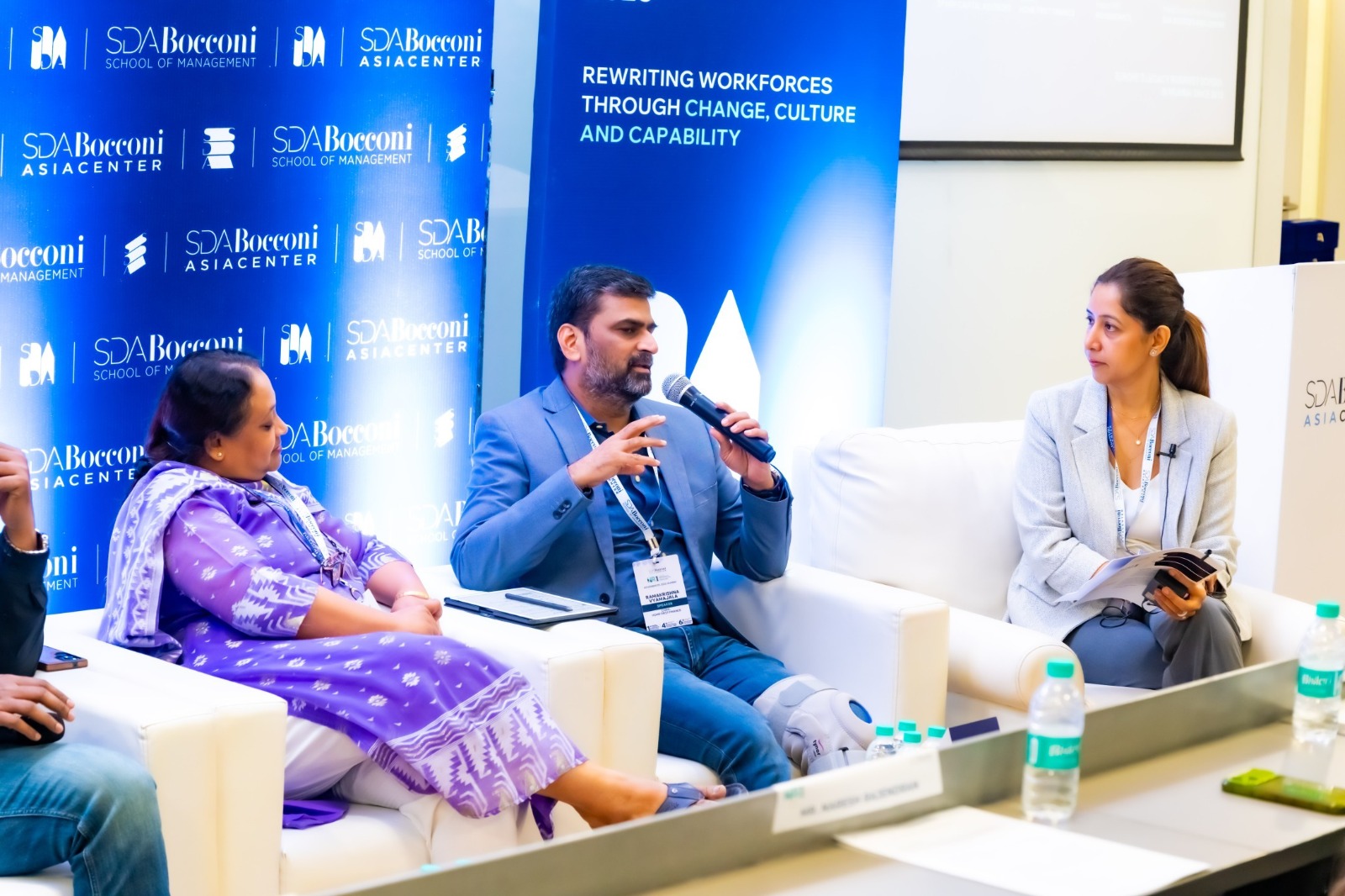
The opening panel positioned artificial intelligence not as a replacement for human capability, but as a strategic enabler that amplifies human potential across business functions.
Featured Speakers:
- Ramakrishna Vyamajala, CHRO – Home First Finance
- Rekha Desai, Head HR – BioGenomics
- Manoj Kumar Sharma, President & CHRO – Aarti Industries
- Naresh Rajendran, Director HR – Europe & IMEA Region (Water Utility Business), Grundfos
- Moderator: Dr Shibani Belwalkar, Head of Executive Education and Professor of Human Resource Management at SDA Bocconi School of Management’s Asia Center
The panelists explored how AI is revolutionizing talent acquisition, succession planning, operational control in manufacturing and pharma sectors, and customer experience in financial services. A critical insight emerged: AI must be viewed as a comprehensive business strategy rather than merely an HR initiative.
The discussion emphasized several key themes including workforce upskilling and reskilling initiatives, building confidence across different generations of workers, fostering outcome-driven organizational cultures, and fundamentally redesigning HR roles for an AI-augmented workplace. The panel’s unified message resonated powerfully: AI will never replace human potential, but HR professionals who strategically embrace AI will define the future of work.
Panel 2: From Culture Fit to Culture Add – The Changing Face of Inclusion

The second panel delivered a thought-provoking exploration of how organizations must reimagine their cultural foundations to build genuinely inclusive and future-ready workplaces.
Featured Speakers:
- Krithivasan S, CHRO – Prayagh Consumer Pvt. Ltd.
- Vijeesh Nair, Global Head – HR – Keemti Jewels
- Loly Vadassery, CHRO – Datamatics Business Solutions Ltd.
- Manmohan Kalsy, CHRO – Inbrew Beverages
- Priya Vasudevan, CHRO – Ex-Liberty General Insurance
- Moderator: Dr KJ George, Director – Learning & Development at SDA Bocconi Asia Center
The discussion reframed organizational culture as a living ecosystem shaped by daily behaviors, leadership decisions, and shared narratives. A transformative shift from “Culture Fit” to “Culture Add” emerged as a defining mindset, encouraging organizations to embrace dissent, fresh perspectives, and cognitive diversity rather than seeking homogeneity.
The panel emphasized that authentic inclusion must be measurable through tangible metrics such as attrition patterns, engagement depth, and promotion equity. Leaders were challenged to embody integrity, openness, and consistency while recognizing that contemporary employees, particularly Gen Z, expect transparency, purpose, and psychological safety. The discussion also addressed how hybrid workplaces require intentional rituals to maintain human connection and organizational cohesion. A powerful reminder emerged: while strategy provides direction, culture ultimately determines whether people can successfully execute it.
Panel 3: Generation Clash – Redesigning Work for a Multi-Gen Workforce
The third panel tackled one of the most complex challenges facing modern organizations: managing five generations working side by side, each with distinct expectations, communication preferences, and motivational drivers.
Featured Speakers:
- Wriddhee Maitra, Head HR – Gland Pharma
- Mohini Palchowdhury, Global Head People & Culture – Quantiphi Analytics
- Saveetha Lakshmanan, Global HR Head – Tagit
- Arvind Tripathi, Head HR – Alembic Pharma
- Subramanian S, Senior Lead – APAC Early Careers, British Petroleum
- Moderator: Jason Enamkel, Manager – Central Team HR at Native
The panel challenged common stereotypes about generational differences, arguing that core human needs remain fundamentally universal: respect, professional growth, and economic security. However, the context shaping each generation differs dramatically, influenced by factors such as economic recessions, technological advancement, and evolving social mobility patterns.
Reverse mentoring emerged as an essential tool for bridging digital and cultural gaps between generations, allowing younger employees to share technological fluency while learning institutional knowledge from experienced colleagues. The panelists emphasized that modern leadership requires transparency, psychological safety, and flexibility in approach. A standout insight captured the essence of the discussion: “The needs are the same; the urgency has changed.” Organizations must adapt their leadership styles and build cultures where every generation feels genuinely heard, valued, and empowered to contribute.
Panel 4: The Shadow Workforce – Managing Gig, Contract, and Remote Talent
The final panel explored the rapidly expanding shadow workforce—gig workers, contractors, freelancers, and remote talent—and how this segment is transitioning from a peripheral resource to a strategic organizational asset.
Featured Speakers:
- Amrita Kachroo Binu, Head HR – Metropolis Healthcare
- Aarti Kohli, CHRO – Bausch & Lomb
- Prakash Hegde, Founder & CEO – Sidhveda HR Solutions LLP
- Moderator: Meka Venkata Chalapathy, Senior Director HR – Virtusa

The discussion highlighted India’s evolving labor law consolidation and how it’s reshaping formal frameworks for gig workers. Organizations are shifting from traditional role-based models to skill-based workforce architectures, recognizing gig workers as brand ambassadors who require genuine inclusion in company culture rather than treatment as temporary, disposable resources.
Automation in healthcare and manufacturing sectors is fundamentally restructuring job design and workforce composition, while the introduction of social security provisions for gig workers represents a historic turning point in workforce policy and worker protections. The panel’s message was unequivocal: the shadow workforce isn’t a future trend to prepare for—it’s the present reality that demands immediate strategic attention. Organizations must redesign policies, embrace operational flexibility, and build cultures where gig and full-time workers coexist seamlessly and productively.
The Road Ahead: Building Human-Centered, Intelligent Organizations
HR1 2025 at SDA Bocconi Asia Center reinforced that the future of human resources exists at the intersection of people, culture, capability, and intelligent systems. From AI-driven strategy and cultural evolution to multigenerational synergy and alternative workforce integration, the event showcased a clear vision: tomorrow’s successful organizations must be adaptive, empathetic, skill-driven, and genuinely inclusive.
The conclave demonstrated that leadership in the modern era requires balancing technological advancement with human-centered values, creating environments where every individual—regardless of employment type, generation, or background—can thrive and contribute meaningfully to organizational success.
As organizations navigate this transformative period marked by constant disruption, the insights shared at HR1 2025 serve as a comprehensive roadmap for building workforces defined by agility, belonging, and purposeful leadership. By embracing effective change management, promoting continuous learning through upskilling and reskilling, establishing strong remote and hybrid work policies, developing resilient strategies for economic uncertainty, and integrating sustainability and social responsibility, organizations can position themselves to remain future-ready.
About SDA Bocconi Asia Center
SDA Bocconi Asia Center is a pan-Asian hub in Mumbai that has been delivering Executive Education and Postgraduate Programs designed by SDA Bocconi School of Management, Italy, since 2012. Recognized among the top International MBA colleges, we bring over 50 years of management education excellence to the Indian and Asian markets.
SDA Bocconi School of Management is ranked among the top business schools globally, recognized as the 4th best Global MBA Worldwide (2025) and 6th Best B-School in Europe (2024) by the Financial Times. With a legacy of academic rigor, cutting-edge research, and industry-relevant curriculum, we empower individuals and organizations through innovative managerial knowledge and a global perspective.